
Recently, thanks to my sister Coleen, I have completely fallen in love with a children’s book entitled I’ll Love You Till the Cows Come Home and the follow up, I’ll Love You Till the Crocodiles Smile. They are arguably two of the cutest and most clever children’s books I’ve ever read. And yes, I know how that sounds but you just have to trust me.
I started doing some research on that expression, “Till the cows come home,” and I found out it is an actual thing. The cows really do come home!
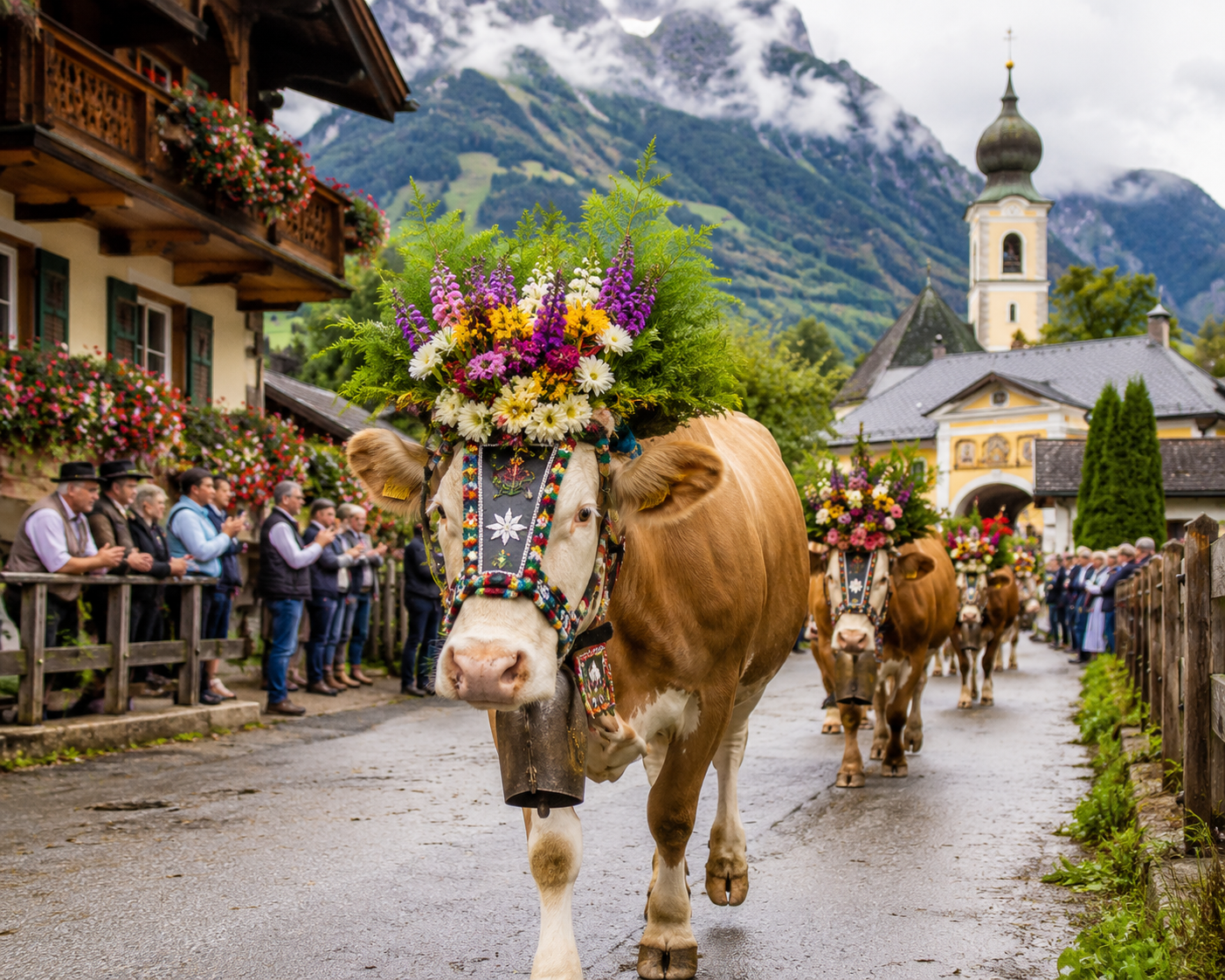
One of the oldest and most beautiful Alpine traditions in Austria, parts of Germany, and Switzerland is this: every spring, farmers take their cows high into the Alps to graze on mountain meadows all summer long.
In early fall, usually September or October, the cows “come home” to the villages before winter snow arrives.
And somehow… this practical farming task turned into an enormous cultural celebration.
The cows are often decorated with:
- giant flower crowns
- evergreen branches
- ribbons
- embroidered harnesses
- huge bells
According to Wikipedia, one special cow, often the lead cow, may wear an elaborate crown-like arrangement called a Kranzkuh (“wreath cow”). And in some traditions, the decorations include crosses or mirrors meant historically for protection and blessing.
If the summer passes without serious accidents or deaths for the herders or animals, the cows are decorated in celebration and gratitude. If there is a tragedy during the season, the cows often come down without decorations.
The bells are one of the most memorable parts. It is said that you hear them before you see the herd, the deep clanging echoing through the mountains and villages.
The whole thing becomes a village festival:
- traditional music
- folk dancing
- markets
- local cheese and bread
- beer and schnapps
- people in traditional clothing
- entire towns lining the streets
Underneath the wreaths and the flowers and celebration, though, there’s something deeper going on culturally.
These Alpine communities spent centuries depending on the mountains for survival. Summer grazing high in the Alps allowed villages to preserve valley farmland for winter hay and crops.
The movement of the animals literally shaped the Alpine landscape and economy for generations.
And the return of those animals became a beloved tradition.
Merriam-Webster defines “tradition” as an inherited, established, or customary pattern of thought, action, or behavior.
We need traditions because things that are steady, reliable, and always there often stop registering with the same emotional weight. Our brains acclimate to them and they just become routine.
Homework and packed lunches.
Rides to practice and permission slips.
Laundry and grocery lists.
Calendars and carpools.
Ordinary Tuesdays.
Work deadlines and unanswered emails.
Dinner plans and dishes.
Dance concerts and football games.
Bedtimes and alarm clocks.
Years quietly passing in the background of our everyday lives.
But traditions interrupt those things.
They create intentional pauses and attention around things that might otherwise blur into the background through repetition alone.
We humans seem to need rituals, holidays, anniversaries, reunions, graduations, birthday candles, church and community gatherings, and yes, Mother’s Day, partly because they help restore proportion to things we’ve adapted to.
They help us see familiar things with fresh eyes for a moment, before life speeds back up again.
So that Alpine “cows coming home” tradition carries relief and gratitude for the harvest. It carries seasonal transition and survival and community identity.
Misty mountains, spring air, old church bells, favorite foods, quaint villages.
And people waiting in the streets for the tradition of flower-crowned cows returning home.
I can’t wait to hear about what your traditions are doing for you. And if you need help creating more intentional pauses in a life that moves very quickly, I’d love to help.
PS Happy Mother’s Day to my momma. The one who taught me about traditions. I read the books I mentioned here to her yesterday and we laughed and laughed – and cried.
.
.
.
.
.
.
.
PPS If you liked this post – or any others, I’d love you to pass me and my work on to a friend. They can find out much more about me here if they’re interested!