
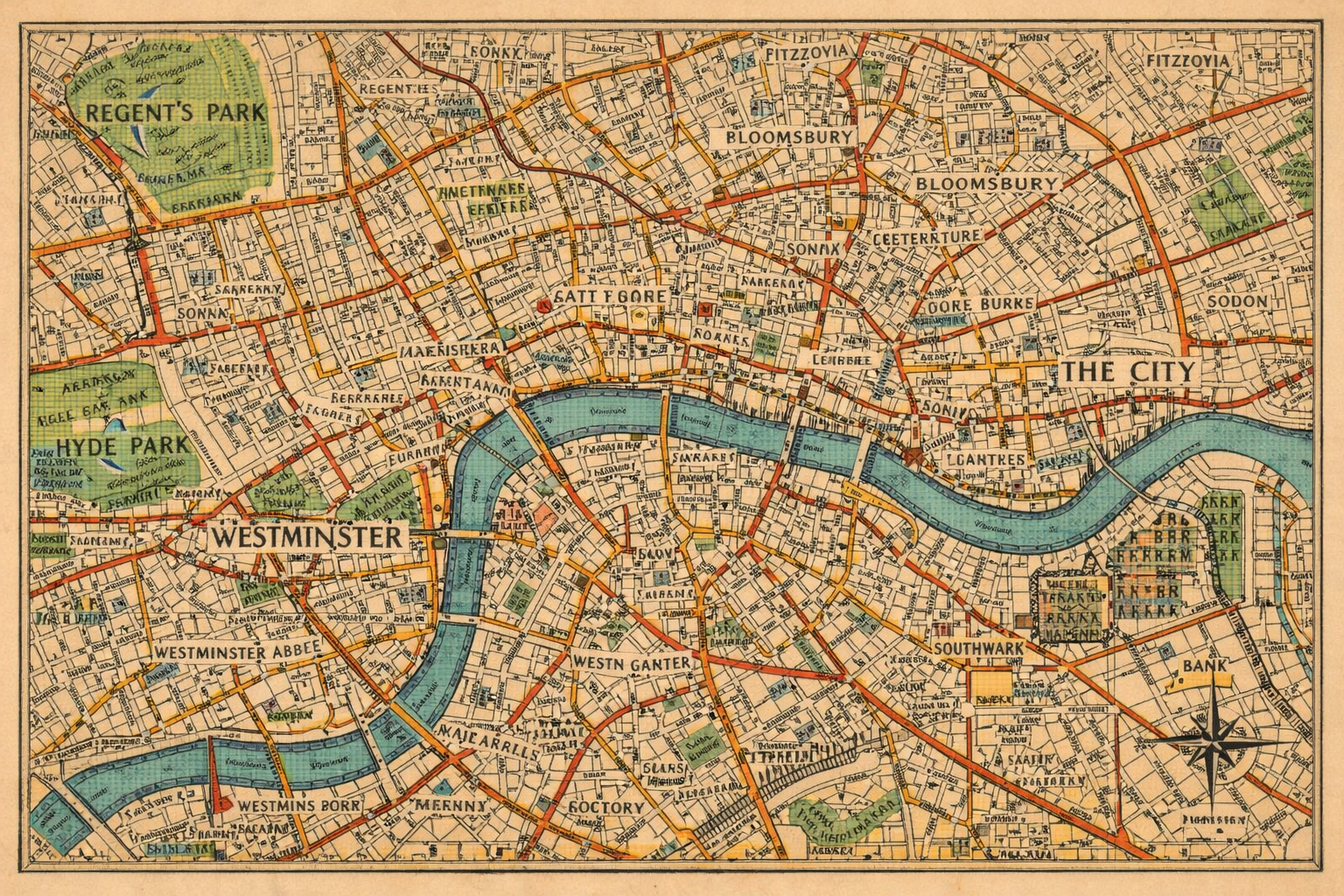
According to several Wikipedia articles, taken from several angles, Phyllis Pearsall (1906–1996) is often credited with creating the first comprehensive, user-friendly street atlas of London.
The popular narrative suggests that in 1935, after getting lost on her way to a party due to outdated maps, she decided to map the city herself. Allegedly, she walked over 3,000 miles, cataloged 23,000 streets, and compiled the information into what became known as the A–Z Atlas.
Phyllis’s father, Alexander Gross, was a cartographer who had previously established a map publishing company. Some sources indicate that Phyllis’s work on the A–Z may have built upon her father’s existing cartographic materials rather than starting entirely from scratch.
But despite debates over the origins, the A–Z Atlas became a significant success.
The next year Phyllis founded the Geographers’ A–Z Map Company. And, at 80 years old, her contributions to cartography were recognized when she was appointed a Member of the Order of the British Empire.
All of that effort from Phyllis produced something the people of London in the 1930s and ‘40s (and beyond!) deeply appreciated: a clear way to understand where they were and how the city fit together.
Today, that kind of guidance is everywhere.
We have apps, millions of books, expert videos, news outlets, more podcasts than we can feasibly listen to, courses, frameworks, opinions, and advice from people who seem to have “figured things out.”
If access to guidance automatically created confidence about the direction we should take, most of us would feel remarkably certain about our lives.
Yet many people feel the opposite.
Psychologist Barry Schwartz, author of The Paradox of Choice, has written extensively about how an abundance of options can make decisions harder rather than easier. When we are surrounded by countless possible paths, people often become less confident in the path they choose.
In other words, when the number of possible routes multiplies, confidence in direction can actually shrink.
When trying to sift through all the guidance, it can help to pause and ask questions like these:
- Who or what consistently helps me see things more clearly?
- Whose ideas have actually helped me change something in my real life for the better?
- Who speaks from experience that really resembles the terrain I’m currently walking?
- Which voices leave me feeling steadier or uplifted rather than stirred up?
- Who offers guidance I can realistically apply in the life I’m living right now?
Most of us already have plenty of guidance.
What often helps is fewer voices and more space to think.
An atlas like the one Phyllis Pearsall created helped Londoners see where they were.
Once they could orient themselves within the city, choosing their own route through those 23,000 streets became much easier.
I can’t wait to hear which voices you decide are worth listening to.
And if mine happens to be one of them, I’d be happy to help you think it through.
.
.
.
.
.
.
.
PS If you liked this post – or any others, I’d love you to pass me and my work on to a friend. They can find out much more about me here if they’re interested!