

My friend Allyson, whom I’ve spoken about here before, is allergic to garlic.
So imagine my surprise when I was recently watching a cooking show and heard the guy talking say that the compound responsible for garlic’s distinctive taste and smell is called allicin. Allicin!
I mean, COME ON. Naturally, I had to deep dive.
Here’s what I learned:
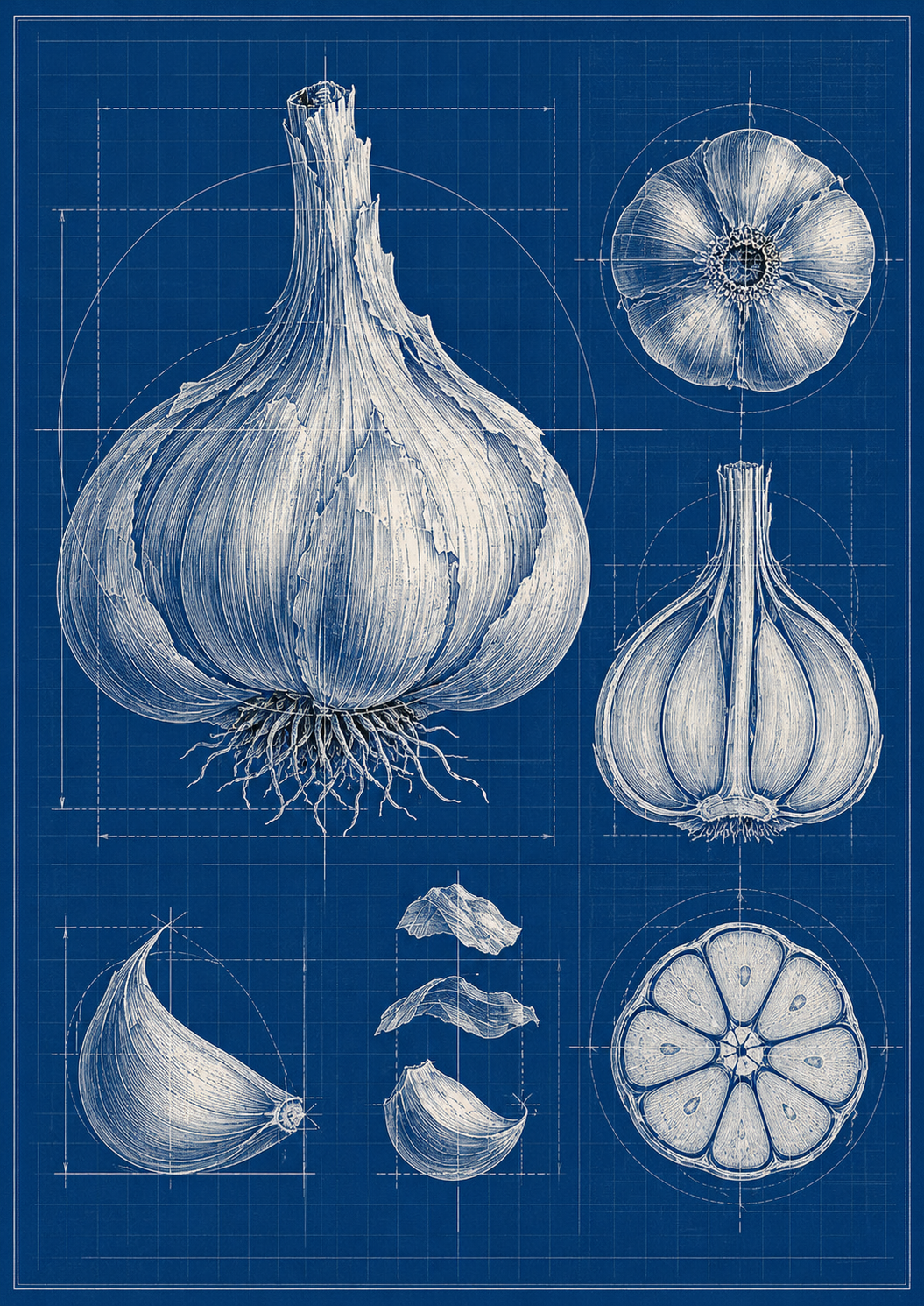
Garlic contains a sulfur-containing amino acid derivative called alliin and an enzyme called alliinase. In an intact clove of garlic, these two substances are stored in separate compartments within the plant’s cells. The alliin is found in the cytoplasm, while the alliinase is stored in little structures called vacuoles.
As long as the garlic’s cells remain intact, the two substances have very little opportunity to interact.
BUT when garlic is chopped, crushed, or chewed, the cell membranes are disrupted, which allows the alliin and alliinase to mix. The alliinase rapidly breaks down the alliin, which produces another compound called sulfenic acid, which then reacts to form, yep!, allicin.
And this happens FAST. Research has shown that approximately 97% of the reaction can be completed within 30 seconds at room temperature.
Allicin, which belongs to a family of sulfur compounds, is responsible for much of the really sharp flavor and pungent aroma of freshly crushed garlic. (Apparently, this chemical reaction that produces allicin is part of garlic’s natural defense system against insects, bacteria, and other potential threats.)
But wait, there’s more!
When garlic is heated, the allicin breaks down into other sulfur-containing compounds which contribute to garlic’s changing flavor and smell. Heat deactivates the alliinase enzyme, limiting allicin production.
That’s part of the reason raw garlic can taste so sharp and strong, while roasted garlic becomes considerably sweeter, milder, and more savory.
I have always wondered why we can eat cloves and cloves of garlic – as long as it’s roasted.
Same clove of garlic. Different circumstances. Different results.
We humans maybe are more like garlic than we think.
We’re the funny one in our family, but fairly quiet at work.
Or we’re patient and understanding with our friends, but find ourselves getting irritated much more easily at home.
Or we’re comfortable speaking up and sharing our opinions with people we know well, but find ourselves second-guessing everything we say at book group.
Or we can handle an enormous amount of responsibility in one area of our lives, but feel completely overwhelmed by something seemingly insignificant in another.
I’ve certainly noticed this in myself. There are circumstances where I feel capable and confident, and others where I seem to have misplaced both of those qualities.
Sometimes we overlook just how much our circumstances (and what we’re thinking about them) contribute to our reactions.
We have our personalities, our experiences, our habits, and our thoughts. And then we bring all of those things into contact with other people, environments, expectations, and situations.
We can’t control every ingredient in every situation, but there may be more we can influence than we realize.
We spend a lot of energy – A. LOT. – trying to change our reactions without sometimes considering the conditions that are helping produce them.
Here are some questions we could ask ourselves when we notice a pattern we dont’ love in our own behavior.
- Where does this tend to happen? Is there a particular environment or situation where I regularly have this reaction?
- Who or what seems to influence it? Are there people, expectations, or circumstances that consistently bring out a particular side of me?
- What changes when the circumstances change? When do I find it easier to respond the way I’d like to?
- Is there something in this combination I can influence? Could I change my approach, adjust a thought or expectation, or create a different environment?
I can’t wait to hear what you discover when you take a closer look at the circumstances that bring out different sides of you. And if you’d like some help sorting through those combinations, I’d love to help – whether your name is Allyson or Edward (IYKYK.)
.
.
.
.
.
.
.
PS If you liked this post – or any others, I’d love you to pass me and my work on to a friend. They can find out much more about me here if they’re interested!