

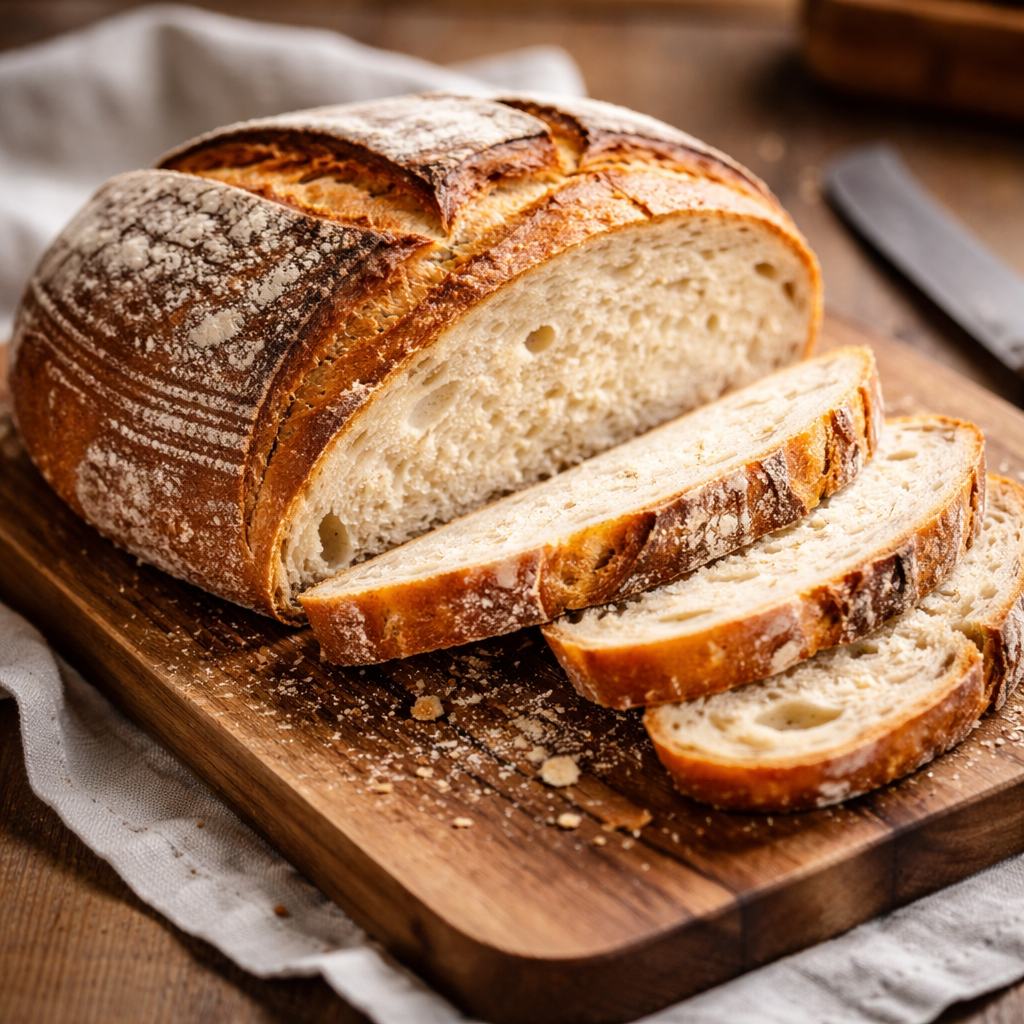
There are at least a dozen reasons why I don’t make bread. The first is that it’s hard. I recently had a friend (she knows who she is) tell me that she spent over a year learning how to make sourdough bread that she was happy about. Over a YEAR.
I do have one dinner roll recipe that is pretty foolproof but I accidentally over-proof it all the time. The rolls still taste good, because how bad can a homemade roll be, but they’re far from perfect.
Yeast bread rises through a scientific process called fermentation. In scientific terms, the rise of dough depends on the interaction between gas production and the dough’s internal structure.
During proofing, yeast metabolizes sugars and produces carbon dioxide (CO₂) as a byproduct. That gas is what creates expansion. On its own, though, gas production is not enough to create a visible rise.
For the dough to expand, it must already contain a developed gluten network. Gluten is formed when proteins in flour (gliadin and glutenin) combine with water and are mechanically worked (kneading or mixing). This creates a structure that is stretchable enough to expand, and strong enough to hold shape.
As CO₂ is released:
- The gas becomes trapped within this gluten network
- Small air pockets expand into larger bubbles
- The dough increases in volume as the network stretches
If the gluten network is underdeveloped:
- Gas escapes instead of being retained
- The dough shows little or no rise
- The final structure is dense or collapsed
If the network is well-developed:
- Gas is retained efficiently
- The dough expands uniformly
- The structure can support and maintain the increased volume
So, yes, the rise is a result of gas production. But, it also depends on whether the dough has the internal capacity (structure and elasticity) to retain and support that expansion.
Internal capacity to support expansion.
Macia Reynolds, Psy.D., offers this idea: Our brains prefer that we go about our days based on how we defined ourselves in the past. Our brains like the security of repetition and certainty, even when we know we can improve.
The convenient, unexamined rationalizations our brains quickly formulate to protect our outdated self-perception allow us to dodge the uncertain process of personal transformation.
And Maja Djikic, author of The Possible Self, says, “Who we believe we are is often the enemy of who we want to become.”
In other words, when it comes to personal growth, the version of us we’ve gotten used to can struggle to hold what’s trying to expand.
How do we build some structure to rise to and hold new growth? Here are 5 ideas.
- Notice where growth is already stretching you.
Pay attention to where things feel a little tight, a little unfamiliar, a little exposed. That edge often shows you where capacity is starting to expand.
- Let the process feel uncomfortable without rushing to fix it.
When something is stretching, it rarely feels smooth. Give yourself some room to sit in that feeling. This can help you stay with it long enough for the structure to strengthen.
- Simplify what you’re trying to carry while something new is forming.
When dough is rising, you’re not adding more ingredients, you’re letting what’s already there do its work. Looking at what you can set down or pause for a bit can create space for that structure to develop.
- Try strengthening the basics that support you.
Sleep, routines, a few steady people, and a place to think out loud can be simple things that make it easier to hold more without everything feeling unstable.
- Give yourself time to adjust to the new shape of things.
Growth changes how things feel. Letting yourself catch up to that mentally, emotionally, and practically can help you hold onto what’s expanding instead of feeling like it’s slipping away.
I can’t wait to hear about what’s expanding for you and how you’re learning to support it. And if you need help with it, let’s talk. Maybe over a loaf of (homemade by someone else!) sourdough and some really good, salty butter.
.
.
.
.
.
.
.
PS If you liked this post – or any others, I’d love you to pass me and my work on to a friend. They can find out much more about me here if they’re interested!