

According to Apple music, “Edvard Grieg wrote melodies that capture the imagination and touch the heart. He was loved the world over. A fine pianist and inspiring conductor, he managed to fuse music that captured the Norwegian spirit with a truly international language; it made him a national hero.”
Sometime I’ll get into the details of why my Dad, whose paternal family hailed from Denmark, actually had a love affair with Norway. But because of his love of that country, its people, and its language, Grieg was his very favorite composer.
He always wanted us to learn songs composed by Grieg. And though I was never accomplished enough on the piano to tackle that feat, I did learn songs by a lot of other composers.
If you have ever taken piano lessons, you probably remember seeing little letters scattered throughout your sheet music:
p.
f.
mp.
ff.
They were telling you how loudly to play.
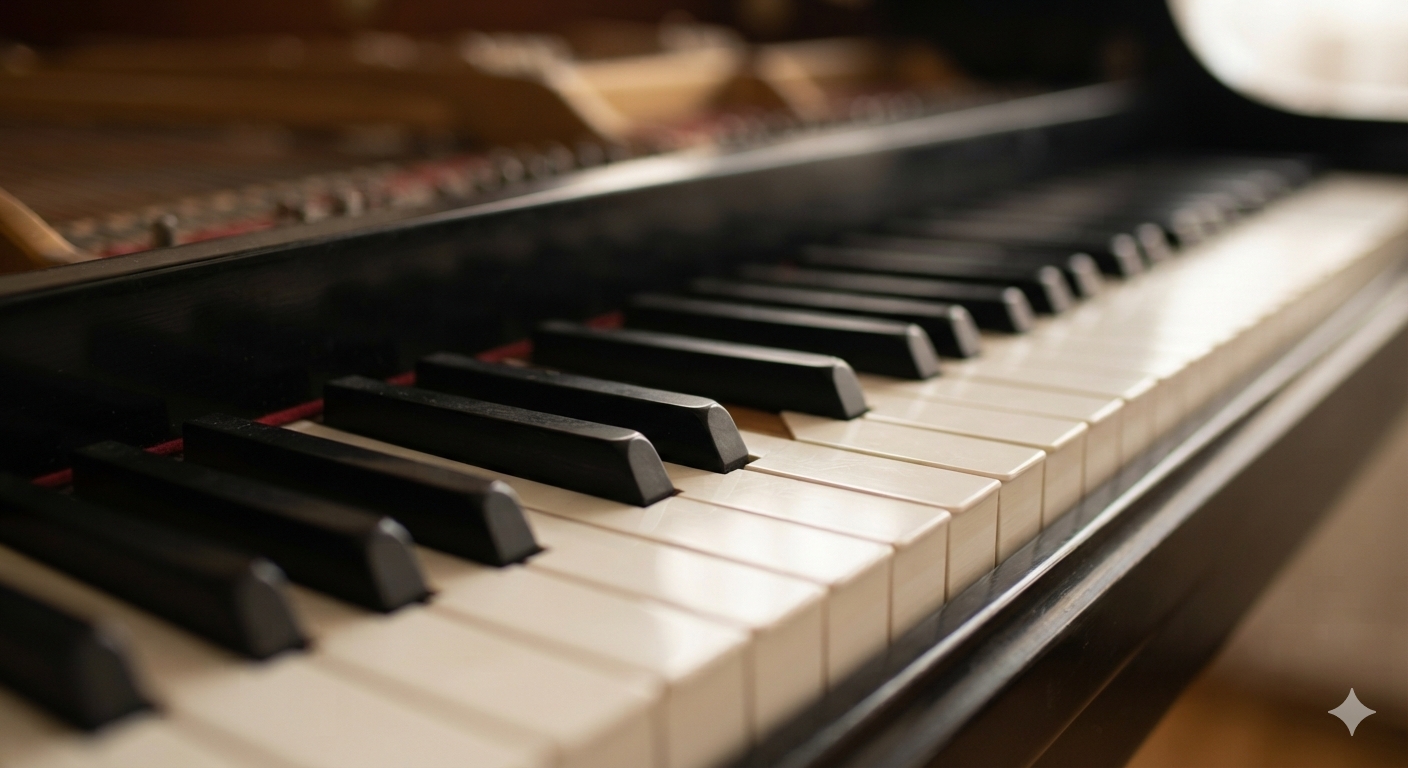
Before the invention of the piano, the main keyboard instrument was the harpsichord. The harpsichord had a major flaw: no matter how hard or how soft you hit the keys, the strings were plucked by a mechanical quill, so it only played at one single, unchanging volume.
It couldn’t express emotion or depth because it was trapped at a flat, constant level.
Around the year 1700, an Italian instrument maker named Bartolomeo Cristofori changed the world by replacing the plucking quills with leather hammers.
For the very first time in history, a musician could sit at a keyboard and control the volume using just the touch of their fingers:
- If you press the keys gently, it plays piano (softly).
- If you strike the keys with force, it plays forte (loudly).
The instrument itself was literally named after its unique ability to handle both ends of the emotional spectrum depending on the touch of the player. The full, original name was the gravicembalo col piano e forte, which translates to “harpsichord with soft and loud.”
Over time, people shortened it to just “pianoforte,” and eventually, people shortened it to the “piano.”
When composers began adding specific instructions for expression to their sheet music during the Renaissance and Baroque periods, Italy was the cultural center of the musical world.
And because Italian composers led the industry, their language became the universal standard for musicians across the globe – a tradition that remains completely intact today.
So those dynamic terms on sheet music that we talked about earlier are all rooted in Italian:
- Piano (p): Softly
- Forte (f): Loudly
- Pianissimo (pp): Very softly
- Fortissimo (ff): Very loudly
- Mezzo-piano (mp): Moderately soft
- Mezzo-forte (mf): Moderately loud
- Crescendo (cresc.): Gradually getting louder
- Decrescendo / Diminuendo (decresc./dim.): Gradually getting softer
That’s 8 different directions for volume on a piece!
James Clear wrote: “Caring about everything is a disaster. Caring about nothing is also a disaster. Nurture the small pocket of things that truly matter to you.”
One of the reasons we struggle with that is because we tend to think caring only comes in two settings: we either care a lot, or we stop caring.
But there are eight different directions for volume on a piece of music.
Maybe something in your life needs to be played forte right now. Maybe something else still matters, but only needs to be played piano for a while.
And maybe there is something you have been giving fortissimo energy to that never deserved quite that much volume in the first place.
Every season of a life requires a different arrangement of forte and piano notes.
Playing something softly can still mean keeping our hands on the keys and choosing the volume it needs right now.
I can’t wait to hear what you are playing forte these days, and what might need to get a little quieter.
And if you need help deciding what the dynamics of your current piece are, I’d love to help.
.
.
.
.
.
.
.
PS If you liked this post – or any others, I’d love you to pass me and my work on to a friend. They can find out much more about me here if they’re interested!