

Piano Man
Take it to the Limit
Moon River
These Are a Few of My Favorite Things
And
Happy Birthday.
What do these 5 songs have in common? Look again – can you guess it?
Answer: they all have an endangered time signature. (Yes, I just made up that term.)
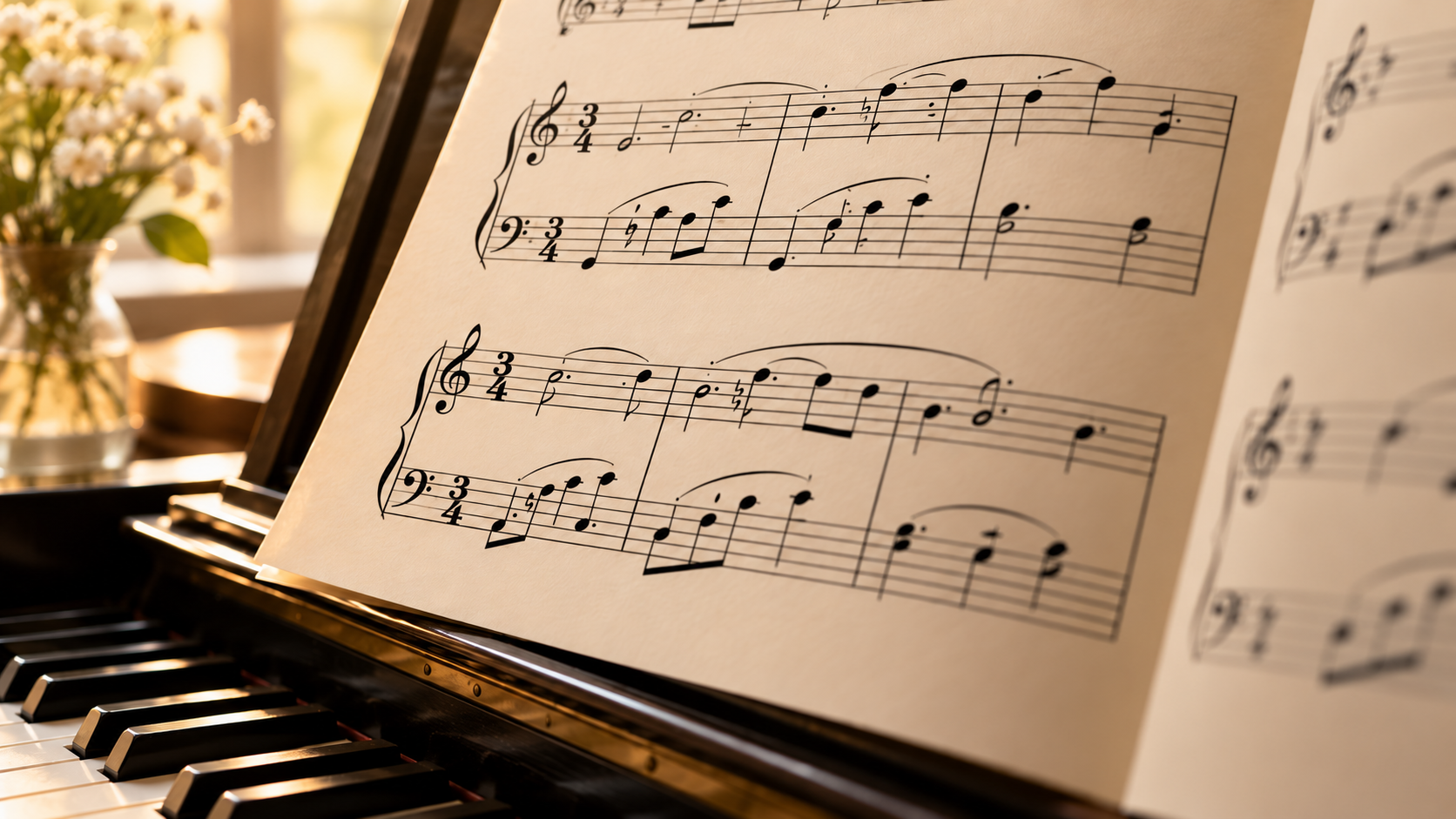
What in the world does that mean? It means that all 5 of these songs are written and performed in 3/4 time.
You might know that most of the music that now plays on our radios or in our playlists is not in 3/4 time. It’s built on a cycle of four beats per measure (4/4 time).
In fact, engineer Michael Tauberg conducted a granular analysis titled “Anatomy of a Hit Song (2000–2018).” He analyzed the audio features, metrics, and musical attributes of the 221 songs that hit Number 1 on the Billboard Hot 100 between January 1, 2000, and December 31, 2018.
His data confirmed that exactly 96% of those Billboard chart-toppers use the 4/4 time signature. 96%!
4/4 time is a predictable march that goes 1, 2, 3, 4. Our feet naturally tap on the odd numbers, and the drums usually snap on the even numbers. It is a symmetrical structure that moves in straight lines. It’s linear, like algebra.
A song in 3/4 time completely changes the math of the music. Instead of a straight line, it moves geometrically in a circle. It drops the fourth beat entirely, forcing the music into a tight, waltzy three-beat loop: 1-2-3, 1-2-3.
(Remember the Carpenters’ version of The Christmas Waltz? There’s actually a line in the song that says, “And this song of mine, in 3/4 time.”)
So why is 3/4 time an endangered time signature?
Four reasons:
- Because we just don’t do as much partner dancing anymore. We’re not all at balls or dinner clubs waltzing on a Saturday night. We do a lot of solo dancing nowadays, so the waltz rhythm lost its real-world function.
- Because 3/4 can naturally drag a song into a heavier, more theatrical emotional space. Commercial pop stations might have gotten used to rejecting it a little because it can “kill the vibe” of a fast-paced playlist or radio block.
- Because the math of 3/4 creates a different rhythmic structure. Four divides evenly into two groups of two, creating the symmetry that works so well for the steady, repeating rhythms of modern pop music. Three doesn’t divide that way. Its uneven grouping creates a different pattern of emphasis.
- Because once something becomes the standard, the standard reinforces itself. Musicians learn to play in 4/4. Producers create in it. Audiences grow accustomed to it. Songwriters naturally return to it because it’s overwhelmingly familiar and commercially successful. Eventually, four beats become the default expectation. And once one rhythm becomes dominant, the world starts organizing itself around that rhythm.
Once one rhythm becomes dominant, the world starts organizing itself around that rhythm.
There are expected rhythms in our lives for how quickly we should make a decision, get over something painful, figure out what we want, finish school, build a career, make friends, get married, have kids, recover from something challenging, get comfortable in a new situation, know what comes next, and on and on and on.
When enough people seem to be moving at the same pace, that pace can start to feel like the correct one.
And then we can start treating our own rhythm like a problem.
So we try to squeeze in a fourth beat, so to speak.
We add urgency.
We add somebody else’s timeline.
We add an unnecessary expectation.
We push ourselves to keep a pace that is not ours.
We assume that because the world around us seems to be counting 1-2-3-4, we should be counting that way too.
But what if Billy Joel had altered Piano Man?
Wouldn’t that have been a shame.
I can’t wait to hear about a place in your life right now where your own rhythm deserves a little more respect. And if you need some help figuring out your own beat, I’d be happy to help.
.
.
.
.
.
.
.
PS If you liked this post – or any others, I’d love you to pass me and my work on to a friend. They can find out much more about me here if they’re interested!