
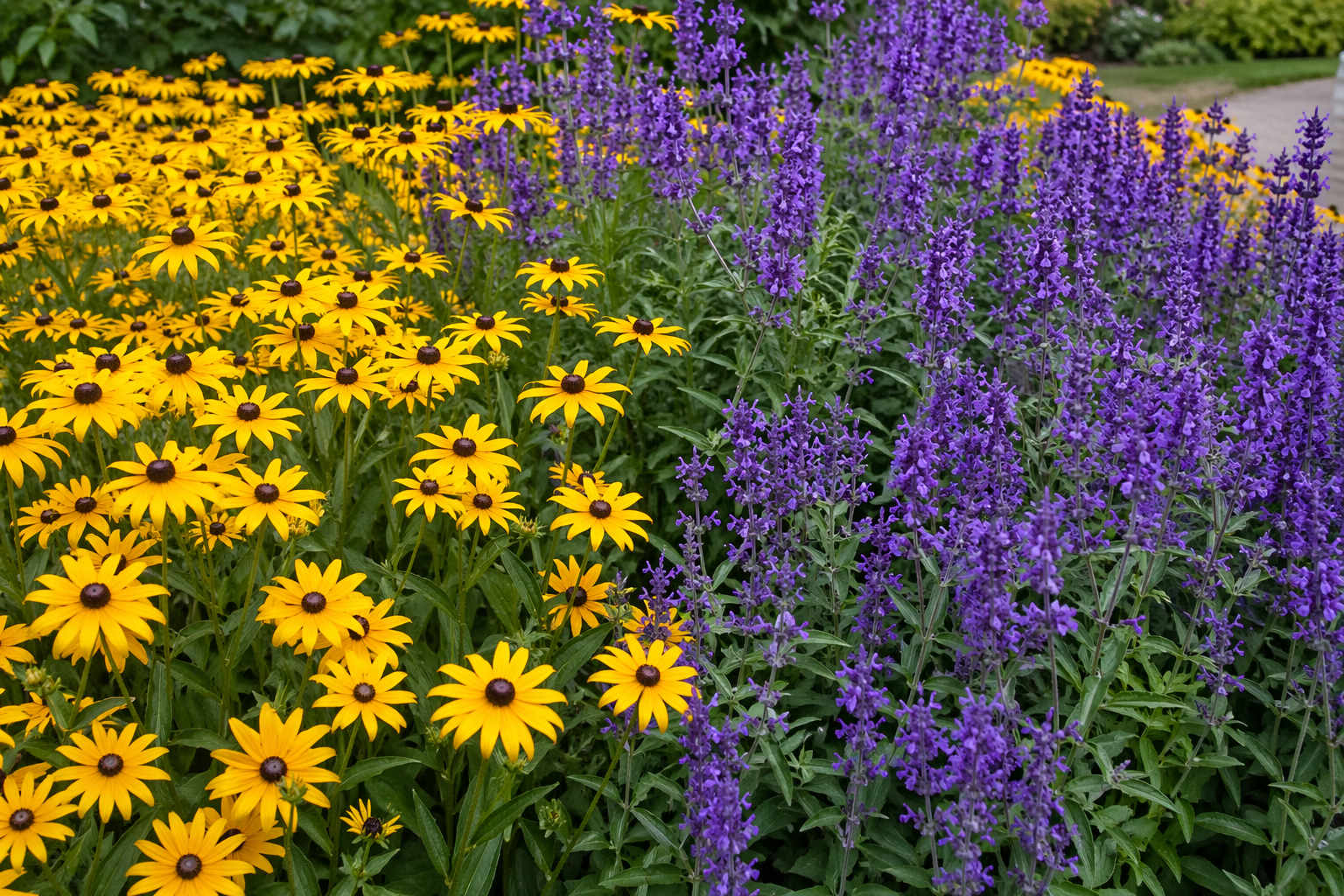
Several months ago on a zoom call, my friend Susie pointed out that purple and yellow flowers often grow next to each other. I am not even a little bit of a gardener, and I had no idea. But once I knew, I started to notice it everywhere. And I got curious.
Apparently, in nature, complementary colors (colors directly opposite each other on the color wheel) often sit side by side. Each sharpens and brightens the other just by being nearby. Their relationship creates high contrast and, next to each other, they create more intensity.
We usually characterize yellow as a warm color, and purple as a cool color, so this contributes even more to the intense visual opposition of purple and yellow.
In its simplest form, an opposite is defined as something that is as different as possible from something else. But there are (at least) three categories of “opposite.”
1. Reverse Direction (Polarity)
This is about things moving or facing in completely different ways.
- Examples: North vs. South, Left vs. Right, Up vs. Down.
- The logic: You cannot move in both directions at the same time; one is the direct reversal of the other.
2. Contradictory States (Binary)
These are “either-or” situations where the presence of one usually means the absence of the other.
- Examples: Alive vs. Dead, On vs. Off, True vs. False.
- The logic: There is no middle ground or spectrum; they are mutually exclusive.
3. Contrasting Qualities (Gradable)
These are opposites that sit at the ends of a scale, with many “shades of gray” in between.
- Examples: Hot vs. Cold, Fast vs. Slow, Large vs. Small.
- The logic: They are defined by their relationship to each other. “Cold” only has meaning because we know what “Hot” feels like.
My guess is, if you’ve ever been in a romantic relationship, you’re familiar with the concept that we often choose partners who possess our ‘opposites’ – strengths that balance our weaknesses. These differences are often the very things that make each person more fully themselves.
This shows up in many, many, many ways.
- Introversion vs. Extroversion: One partner may thrive in social crowds while the other provides a “home base” of quiet and calm.
- Logical vs. Emotional: One person may process decisions through facts and logic, while the other prioritizes feelings and empathy.
- Spontaneous vs. Structured: A “free spirit” who enjoys adventure may be drawn to a meticulous planner who provides stability and order.
- Assertive vs. Easygoing: One person takes the lead on big decisions while the other provides flexibility and peace.
- Verbal processor vs. Internal processor: One person needs to talk things through to understand what they think, while the other prefers to think first and speak once it’s clear.
- Morning person vs. Night owl: One wakes up ready to go, the other hits their stride when the day is winding down.
- Neat vs. Messy: One finds calm in order, the other finds comfort in a little bit of chaos.
- Saver vs. Spender: One feels secure holding onto resources, the other enjoys using them.
- High-energy interests vs. Solitary hobbies: One fills time with movement, people, and activity, the other restores through quiet, individual pursuits.
- Big-picture vs. Detail-oriented: One sees where things are going, the other sees what needs to happen next.
- Decisive vs. Deliberate: One moves quickly, the other takes time to weigh options.
- Optimistic vs. Cautious: One looks for what could go right, the other looks for what could go wrong.
- Direct communicator vs. Gentle communicator: One says things plainly, the other prioritizes tone and delivery.
And on and on and on.
These opposite strengths can be challenging in really predictable ways.
Linda and Charlie Bloom say this about navigating the inevitable struggle these opposites present: “Creating a balance involves the ability to hold the tension of the opposites, without going too far over to one side or the other… There is no fixed or correct point at which we can find some permanent balance. This is a dynamic process and the balance point between the two poles … is constantly in flux.”
Most of us don’t experience this as balance. We experience it as conflict. The thing we were attracted to at first starts to drive us bonkers. But the “Complementary Paradox” says that often opposites are not enemies. They are two halves of a whole. This is the idea behind the Yin and Yang: you cannot have light without shadow, or sound without silence. (This is what the gradable opposite category was referring to, above.)
In this sense, an opposite isn’t just a “different” thing; it is the necessary counterpart that gives the other thing its meaning. So the relationship isn’t stronger when we just blend the colors together. Yellow and purple make a drab brown, after all. It’s stronger when each person is fully themself, in all their yellow or purple-ness, right next to the other.
According to Dr. Vincent Dyer, it helps to pause and remember that friction often lives next to growth. Although it might feel simpler or more comfortable to be with someone who closely mirrors our own traits, it’s often the differences between partners that offer the richest opportunities for learning, for healing, for expanding who we are.”
He goes on to say, “When we approach those differences with curiosity instead of judgment, with compassion instead of control, we create space for connection to deepen. Embracing [each] partner’s unique ways of being allows the relationship to find balance, vitality, and resilience. These differences become not roadblocks, but invitations – paths to empathy, understanding, and stronger emotional intimacy. In honoring what sets us apart, we also discover how much we can grow together.”
I can’t wait to hear what this helps you notice in your own relationships – and where you’re seeing those “purple and yellow” moments. And if you’d like help navigating those differences, I’d love to help.
.
.
.
.
.
.
.
PS If you liked this post – or any others, I’d love you to pass me and my work on to a friend. They can find out much more about me here if they’re interested!