

Justin Willman, the magician-comedian, has a trick that never fails to amaze people. Including me. He’s memorized every zip code in the United States. For real. Audience members call out their five digit zip code, and he tells them their town. Not just the state, not just the region — the actual exact town.
It feels like wizardry, and it’s supposed to.
He’s a magician, after all.
But the way he tells it, his parents bought him a zip code book when he was 12. He had to stay home for a whole summer recovering from breaking both arms. So he decided to memorize ZIP codes. He took memorizing all of them as a challenge.
Zip codes follow a system because the postal service runs on a kind of hidden order. Every letter takes a path we don’t see. It’s collected, scanned, sorted, rerouted, sequenced.
Then, day after day, it is carried along the same streets until it lands in the right mailbox.
Here’s the short version of how it all works.
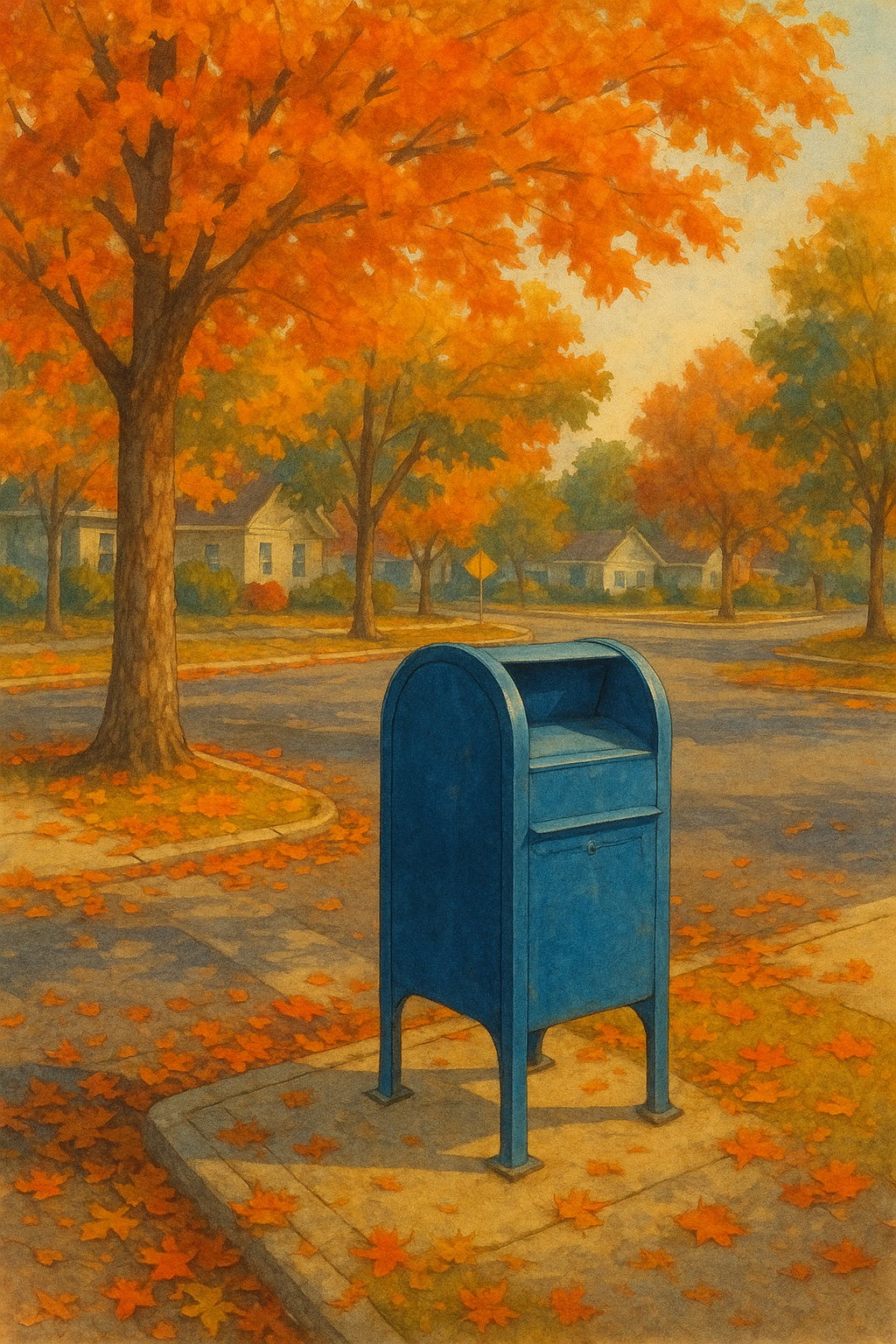
Collection. Mail gets scooped up from blue boxes and post offices and taken to a local processing center.
Sorting. Huge machines called Delivery Barcode Sorters scan every piece. They read the address, spray on a barcode, and start dividing by zip code. Almost all of this happens automatically now, with a precision that takes it all the way down to the order of one carrier’s route.
Routing hubs. If the letter’s staying local, it never leaves the center. If it’s headed farther, it hops to a regional hub, then another hub near the destination, then back down to the local post office closest to the address on the envelope.
Sequencing. Before a mail carrier leaves the post office, the mail is already in order. Not just grouped by street — but lined up house by house, first stop to last stop. Machines and clerks handle the sequence so carriers don’t waste time reordering.
Delivery. Then the carrier sets out, walking or driving the same path they know by heart. Routes don’t change much.
Those machines that sort by zip code are breaking chaos into order. Think about the volume: millions of letters and packages pouring in from every direction. The scanner reads the address in a fraction of a second, the barcode locks it into the system, and the machine spits it into the right bin. Step by step, the random gets organized into something useful.
Maybe you’re drowning in all the small stuff. Or restless with repetition. Or in some state of transition. Or just looking for calm.
Gretchen Rubin says “One of the things about happiness that continually surprises me is the degree to which, for most people, outer order contributes to inner calm, and inner self-command. In the context of a happy life, a crowded coat closet or an overflowing in-box is trivial, and yet such things weigh us down more than they should.”
Taking a lead from the postal service, here’s how you might try putting your own ‘mail’ in order:
Collection. Notice what you’re taking in — tasks, ideas, worries, conversations. Some of it you’ve chosen. Some has just shown up. Write all of it down or gather it into one place instead of carrying all of it in your head.
Sorting. Decide what matters most right now. As in “this belongs here, that belongs there.” Some priorities rise to the top, and it will become more obvious that some things can wait. You just have to have enough order to move forward.
Routing hubs. Pay attention to what needs quick attention and what will take more steps, people, or time. Not everything will stay close to home. Put each thing on the right “route” so you’re not holding it all at once.
Sequencing. Line things up before you begin. This first, that next, etc. Build a small routine — the way you start a morning, the way you wrap up a project — so your energy has a natural order to follow.
Delivery. Then take the steps. Task by task, conversation by conversation. The steadiness of showing up is what gets things where they need to go.
Justin Willman proves that when you know the system, it can look like magic.
I can’t wait to see what sorting moments and steady routes you’re noticing in your own days. And if you need help with any of it, I’d love to talk it through.
.
.
.
.
.
.
.
PS If you liked this post – or any others, I’d love you to pass me and my work on to a friend. They can find out much more about me here if they’re interested!