
In the early 1980s, the famous British actress and mother Jane Birkin received a lucky upgrade on an Air France flight from Paris to London.
She wasn’t carrying her signature wicker basket that day because her partner, director Jacques Doillon, had (purposely) run it over with his car a few days earlier!
Instead, she was using a makeshift bag packed with her daily essentials.
As the story goes, when she tried to put that makeshift bag into the overhead bin, her belongings spilled everywhere. As she scrambled to clean up the mess, she started complaining to the man sitting next to her, wishing Hermès (specifically) would make a bag that could actually hold a busy mother’s things.
By an absolute stroke of fate, the man sitting next to her was Jean-Louis Dumas, a fifth-generation descendant of the company’s founder, Thierry Hermès, and the company’s CEO.
Dumas told her he was Hermès and invited her to describe her dream bag.
Right there in the middle of the flight, they used an airplane barf bag as scratch paper and sketched out a spacious, sturdy leather bag with built-in pockets.
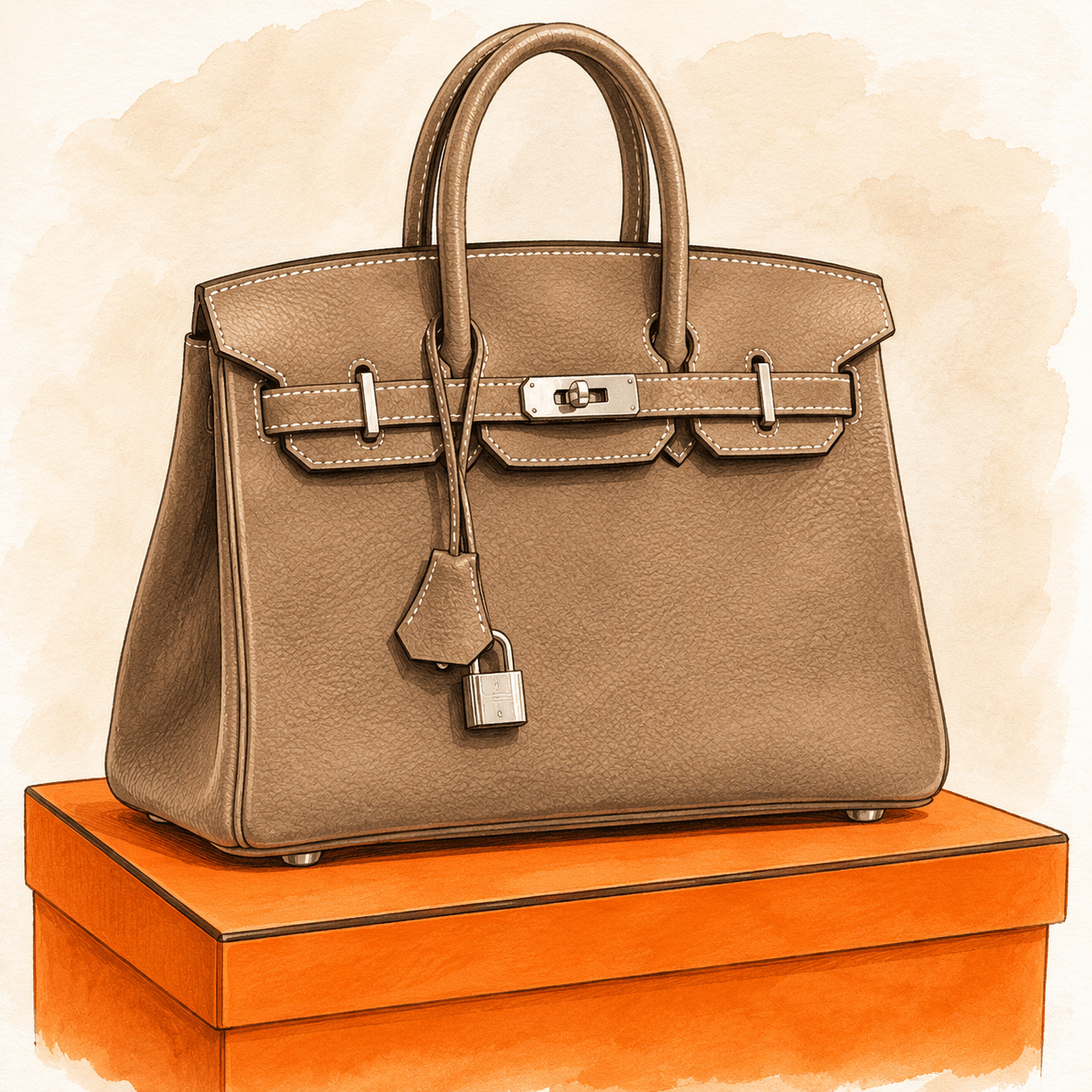
Hermès manufactured the design and released it in 1984, naming it the “Birkin Bag” in her honor.
And that handbag, originally designed because a busy mother needed somewhere to put all her stuff, eventually became one of the most coveted handbags in the whole wide world.
And one of the hardest to buy.
Wait, what?
Can’t you just order a new Birkin bag online?
No.
Can’t you just walk into Hermès store and find one available for purchase?
No.
There isn’t even a straightforward waiting list you can get onto.
You have to be OFFERED the OPPORTUNITY to buy one.
Here’s how it works.
A hopeful Birkin buyer typically establishes a relationship with a particular Hermès sales associate. Over time, they might purchase scarves, shoes, jewelry, or other handbags from that person, building a shopping history and making their interest in a Birkin known.
The sales associate gets to know the customer, their preferences, and what they’re hoping to buy. And at some point, that customer might be offered a Birkin.
It could take months. It could take years. And there’s no official spending requirement or guarantee that an offer will ever come.
Which is a pretty remarkable way to sell an already unfathomably expensive handbag.
I have my cousin Todd’s husband, Jason, to thank for sending me down this particular rabbit hole.
Last December Jason developed a love for Hermès.
He now has beautiful bags and exquisite scarves – oh, and his own personal sales associate: Sam.
Jason is really, really hoping to add a Birkin to his collection.
And hearing about the whole purchasing process from someone who’s actually navigating it made me curious enough to start doing some research.
Because of him, I discovered a psychological term I didn’t know: reactance.
In 1966, psychologist Jack Brehm introduced this theory called psychological reactance.
Essentially, when we feel that our freedom to make our own choices is being threatened, we can experience a powerful urge to reclaim that freedom.
And sometimes that means wanting the very thing we’ve been told we can’t have.
Of course, people want Birkin bags for all sorts of reasons. But the unusual way they’re sold raises an interesting psychological question.
What happens when we want something, have the means to get it, and discover that somebody else gets to decide whether we can?
That can create an entirely new motivation.
At first, the customer simply wanted a beautiful handbag. But now there’s something else involved. There’s an opportunity to gain access to something exclusive, to overcome a restriction, and perhaps even to prove that they belong among the people who get to have one.
The bag may start to represent something beyond the bag itself.
We have a pretty strong attachment to being able to make our own choices. Most of us can probably think of a time when someone else’s restrictions made us considerably more determined to do something.
Think about something you had no intention of doing until somebody told you that you couldn’t. Or the opportunity that suddenly seemed much more appealing when you learned you hadn’t been selected. Or the person whose approval became strangely important once you realized you didn’t have it.
Sometimes the thing we want and the freedom to have it get all tangled up together.
And when that happens, we can find ourselves investing an awful lot of energy in something without stopping to consider what we’re actually hoping to get out of it.
In those cases, we might benefit from asking ourselves 3 simple questions:
- What drew me to this in the first place?
- What am I hoping finally getting it will give me?
- If nobody were standing in my way, would I still want it as much?
Those are pretty useful questions to have tucked away somewhere.
Maybe inside your five-figure handbag, if you can manage to get one.
I can’t wait to hear about a time when something became even more appealing simply because it was out of reach.
And if you could use some help sorting through what you want and why, I’d love to help.
.
PS For the record, I am absolutely rooting for Jason to get that Etoupe 35 Birkin.
PPS Jane Birkin’s original bag, stamped with her initials “J.B.”, sold at Sotheby’s Paris in July 2025 for an astonishing $10.1 million!
PPPS Jason’s initials are J.B.! Come on, Sam! It’s meant to be.
.
.
.
.
.
.
.
If you liked this post – or any others, I’d love you to pass me and my work on to a friend. They can find out much more about me here if they’re interested!