

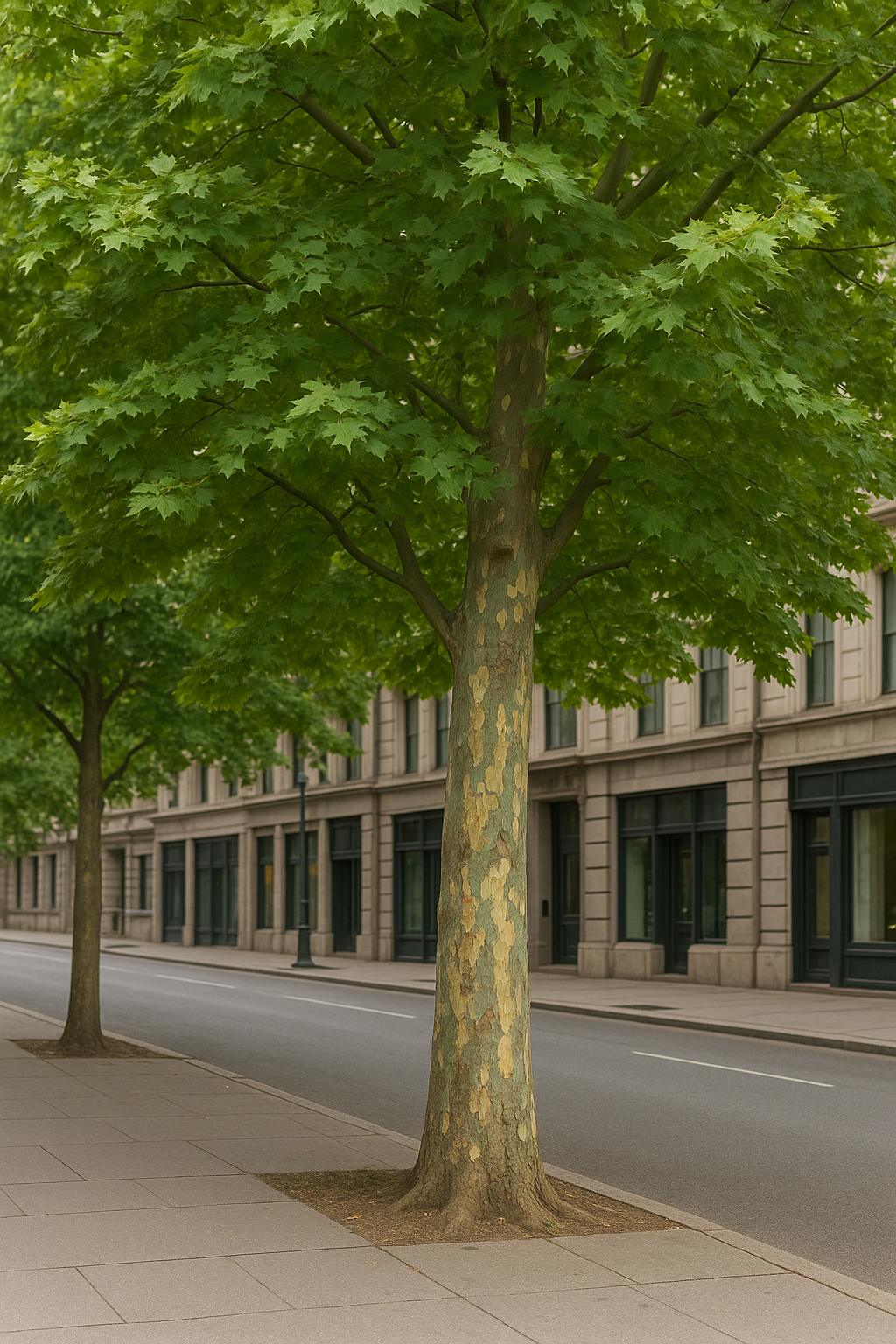
The London plane tree (platanus × acerifolia) is a hybrid between the American sycamore tree and the Oriental plane tree. Wikipedia says it’s believed to have appeared by accident in the 17th or 18th century, possibly in a garden in London or Spain. Botanists noticed that this crossbreed had unusual strength: it could survive soot, smoke, and pollution that killed most other trees.
By the Industrial Revolution, when London’s air was thick with coal dust and factories, the London plane became the only tree that could reliably survive in the city. It tolerated pollution by adapting to it. Its bark would shed in patches, literally sloughing off soot and toxins so the tree could keep breathing. The peeling bark left a mottled trunk — tan, green, gray — the distinctive camouflage look that is still seen lining streets in London, Paris, and New York today.
The London plane tree also has the ability to self-prune damaged branches and filter air unusually well. So over time, city planners started planting it everywhere — because it could keep growing in places where nothing else could.
It’s now one of the most common urban trees in the world — a hybrid of two continents, thriving in the dirtiest conditions humans have created.
I wrote a blog post a couple years ago about my mom’s question, “Is this a tragedy or an inconvenience?”
In it I said this, “During tragic or intense or critical periods of your life, you might want to adopt a micro perspective. One minute, one hour, one day at a time. Next step and then the next.”
Right now – as probably many of you do – I have several people I know and love going through intense, critical periods in their lives, some real personal and financial upheaval.
And my advice from that old post still stands. One minute, one hour, and one day at a time.
Kristen Bradbury, Ph.D., has some additional counsel for them, and for us – when we find ourselves in such a state of crisis. She wrote it during the COVID-19 pandemic and it’s still applicable.
“We are going to get through this. We must keep our wits about us and remain engaged in the present while refusing to lose sight of a reassuring future. We must respond deliberately to … crisis with:
- A renewed commitment to the positive expression of our moral values in our behavior
- Self-care strategies to reduce our stress and ease our reactivity to our … anxiety
- Acceptance that this time of suffering entails great challenge—and the opportunity to prove our positive resilience … with dignity and grace”
Commit to what we value and then behave with those values in mind.
Take care of ourselves in order to manage our stress and reactivity.
Accept both the challenge of the suffering AND the opportunity to prove our resilience.
One client who has contended with a chronic illness for more than a decade mentioned to me this week that she doesn’t want to be known as ‘strong’ anymore. She wants to concentrate her efforts on resilience.
The American Psychological Association (APA) defines resilience as “the process and outcome of successfully adapting to difficult or challenging life experiences, especially through mental, emotional, and behavioral flexibility and adjustment to external and internal demands.”
The APA goes on to say “psychological research demonstrates that the resources and skills associated with more positive adaptation (i.e., greater resilience) can be cultivated and practiced.”
How do we cultivate resilience? How do we become a little more like that London plane tree?
Here are a few of their most practical ideas:
- Prioritize relationships.
- Join a group.
- Take care of our bodies.
- Practice mindfulness.
- Avoid negative outlets.
- Help others.
- Be proactive.
- Move toward our goals.
- Look for opportunities for self-discovery.
- Keep things in perspective.
- Accept change.
- Maintain a hopeful outlook.
- Learn from our past.
- Seek Help.
We often think of resilience as toughness — as being unbreakable. But the London plane’s secret is flexibility and renewal.
The tree doesn’t harden against its environment; it lets go of what’s toxic and keeps growing anyway.
It’s the tree that learned how to survive where others couldn’t.
I can’t wait to hear about how you’re cultivating your own personal brand of resilience. And if you need some assistance with how you’re moving through whatever your challenges may be, I’d love to help.
.
.
.
.
.
.
.
PS If you liked this post – or any others, I’d love you to pass me and my work on to a friend. They can find out much more about me here if they’re interested!